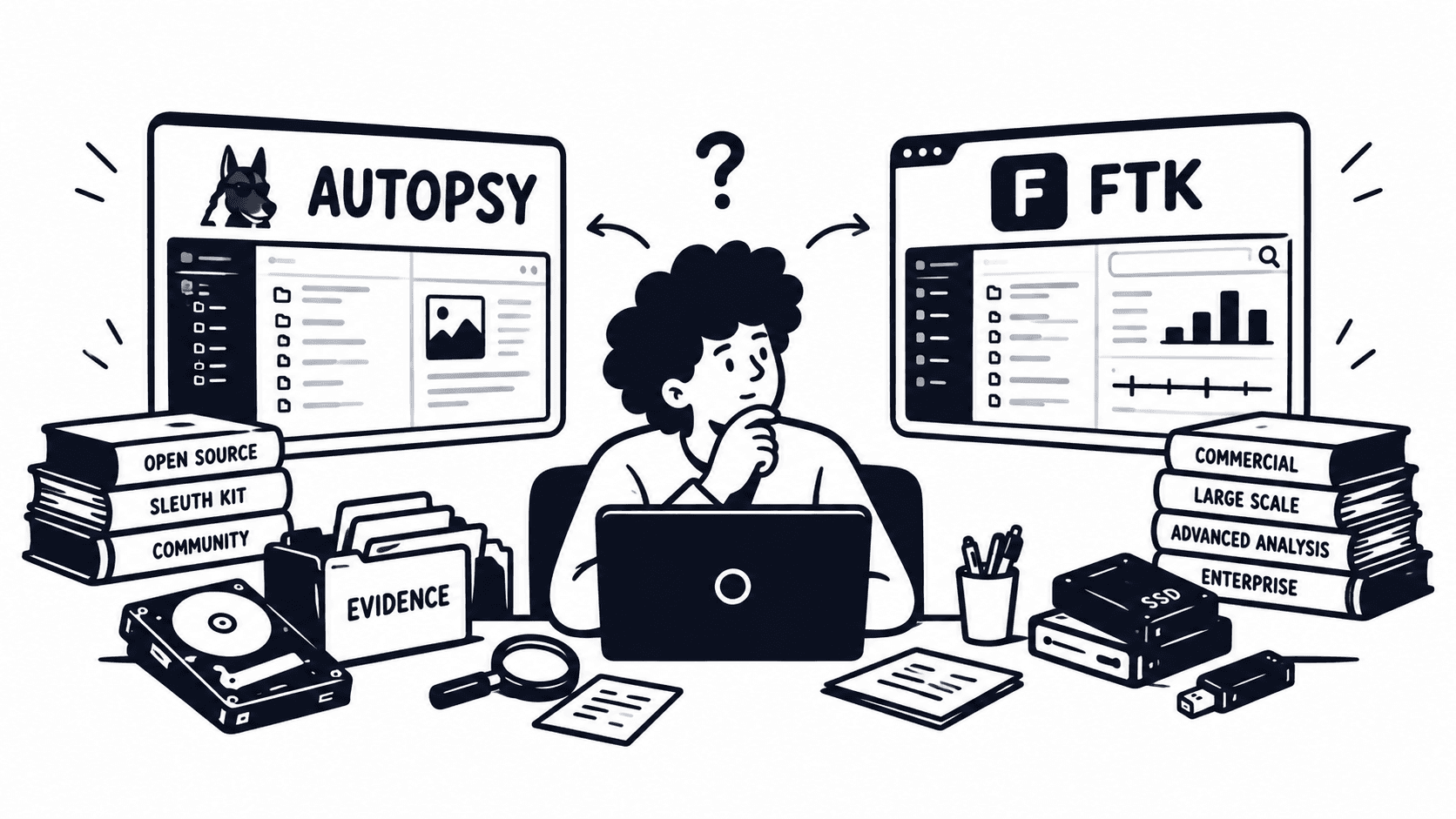
Both can be used to examine digital evidence, but they are not really aimed at the same kind of workflow. I have used this distinction as a simple rule when learning forensic tools: Autopsy is an excellent place to learn how forensic analysis works; FTK is built around a much more commercial, high-performance investigation workflow.
That doesn't mean one automatically replaces the other.
First, What Are They?
Autopsy is an open-source digital forensics platform built around The Sleuth Kit (TSK). It provides a graphical interface for examining disk images and other data sources, running ingest modules, searching evidence, examining artifacts, and generating reports.
FTK (Forensic Toolkit) is Exterro's commercial forensic investigation platform. It focuses heavily on evidence processing, indexing, searching, artifact analysis, timeline analysis, review, and handling large datasets.
So the basic difference is:
Autopsy gives you an accessible, open platform for forensic examination. FTK is a commercial platform designed around large-scale processing and investigation workflows.
Where the Difference Actually Matters
At first glance, both applications look similar.
You can add evidence, browse files, search for keywords, examine artifacts and produce reports.
The difference becomes clearer when you look at how the evidence is processed.
In Autopsy, you create a case, add a data source, select ingest modules and allow them to process the evidence. Results are then made available for manual examination.
Autopsy's architecture is also highly modular. Its ingest framework can process the disk image and individual files through different analysis modules, and third-party modules can be added.
FTK Takes a Different Approach
FTK puts a lot of emphasis on processing and indexing evidence before investigation.
Instead of repeatedly scanning through large datasets for every search, FTK's workflow indexes evidence during processing so investigators can subsequently search and filter that indexed data. Exterro also positions FTK around large-scale processing, artifact analysis, timeline visualization and defensible workflows.
This becomes important when the evidence isn't a 20 GB student image but a case containing hundreds of gigabytes or multiple terabytes of data.
At that point, processing speed and the way the forensic database is structured can have a significant impact on the examiner's workflow.
Autopsy vs FTK
| Features | Autopsy | FTK |
|---|---|---|
| License | Open Source | Commerical |
| Core foundation | The Sleuth Kit | Exterro's FTK platform |
| Disk-image analysis | Yes | Yes |
| File-system analysis | Strong | Strong |
| Keyword searching | Yes | Yes |
| Artifact analysis | Yes | Yes |
| Timeline analysis | Yes | Yes |
| Hash analysis/filtering | Yes | Yes |
| Reporting | Yes | Yes |
| Extensibility | Strong module ecosystem | Commercial ecosystem/integrations |
| Large-scale processing | Suitable, hardware/workflow dependent | Strong focus |
| Learning | Very accessible | More enterprise-oriented |
| Cost | Free | Commercial licensing |
Autopsy supports common file systems, hash-set filtering, keyword searching, file-type identification, timeline functionality and reporting.
FTK similarly provides indexing, searching, artifact analysis, timeline and visualization capabilities, with its current product positioning emphasizing scalable processing and large datasets.
Don't Confuse FTK With FTK Imager
This is where beginners frequently get confused.
FTK Imager is not the same thing as FTK Forensic Toolkit.
FTK Imager is primarily an evidence acquisition and preview tool. It can create forensic images, verify hashes, preview evidence and perform certain live-memory acquisition tasks.
FTK is the larger forensic analysis platform.
A simplified workflow looks like this:
Suspect device → Acquisition → Forensic image → Processing → Analysis → Reporting

FTK Imager can play an important role around the acquisition stage, while FTK is designed for the subsequent processing and analysis workflow.
Which One Should You Learn First?
For a student, I would not make this a “Autopsy vs FTK — which one is better?” question.
Learn Autopsy first.
Not because it is universally better, but because you can freely install it and actually experiment with forensic images without needing a commercial FTK deployment.
More importantly, don't just learn where buttons are.
Take a small disk image and understand:
- File systems
- Partitions
- Deleted files
- Metadata
- Hashes
- Browser artifacts
- Windows artifacts
- Timeline analysis
- Keyword searching
- Reporting
Once you understand those concepts, moving from Autopsy to FTK becomes much easier.
The software is not the forensic skill. The ability to understand what the evidence means is.
So, Are They Competitors?
Yes, in some workflows they overlap heavily.
But thinking of them as simply “free tool vs paid tool” misses the important part.
Autopsy's open architecture and integration with The Sleuth Kit make it particularly useful for learning, experimentation and customizable forensic workflows.
FTK is aimed more heavily at professional investigation environments where processing speed, indexing, large datasets, workflow management and scalable analysis matter.
And in real forensic work, the answer doesn't always have to be one tool. Examiners may use different tools for acquisition, analysis and validation depending on the evidence and investigative requirements.
The Takeaway
If you're starting digital forensics:
Start with Autopsy → understand the evidence → learn the forensic methodology → then learn FTK.
Don't become someone who knows 50 buttons in FTK but cannot explain what an MFT entry, registry artifact or timestamp actually means.
A forensic tool should make your analysis faster. It shouldn't replace your understanding of the evidence.