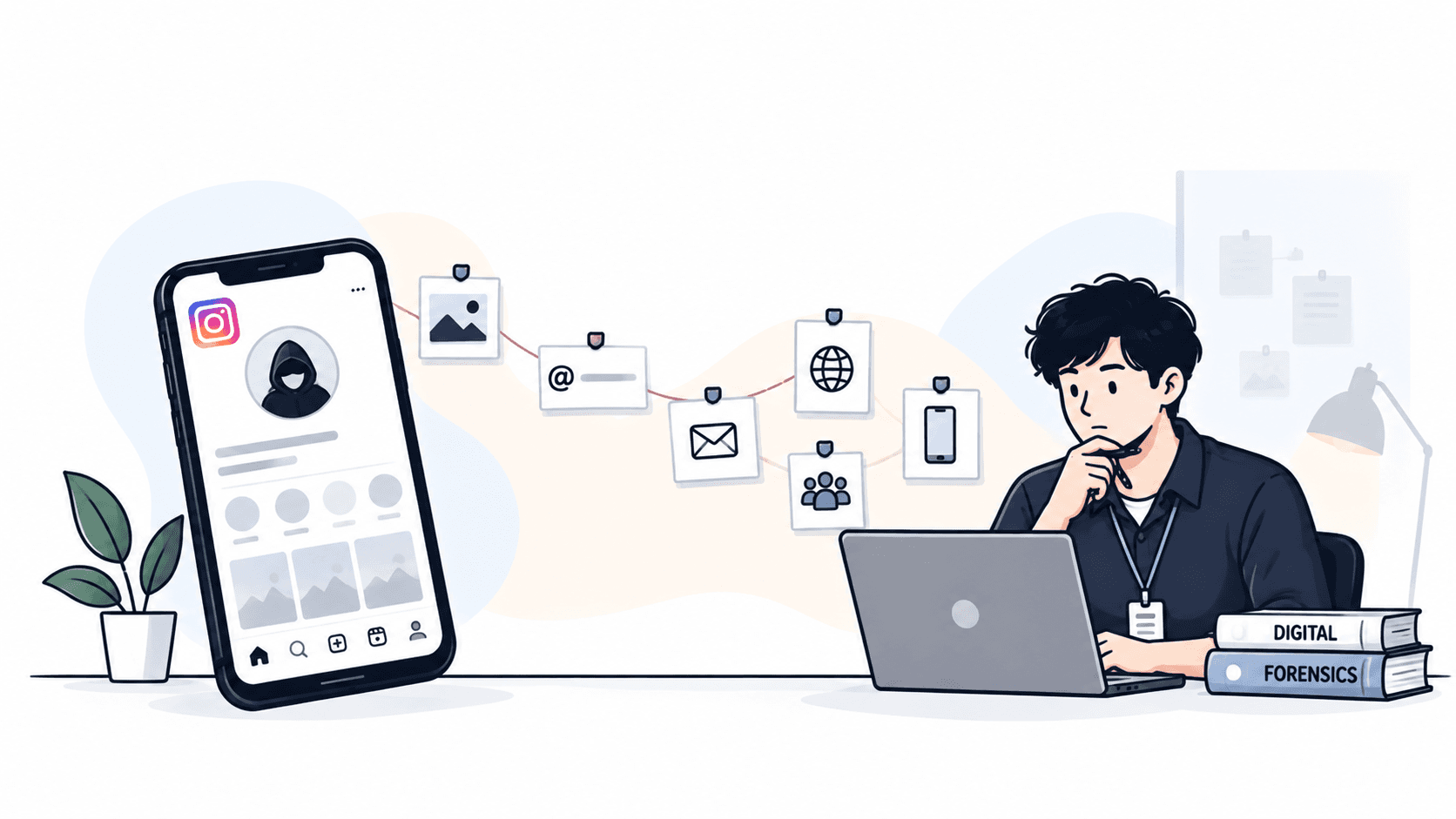
A fake Instagram account can look almost impossible to trace.
There may be no real name, no recognizable photograph, and no obvious connection to the person behind it. From the outside, it can look like the account simply appeared from nowhere.
But investigators usually don't start by asking, “Who is this person?”
They start with a different question:
“What digital traces did this account leave behind?”
That distinction is important because an Instagram username is only one piece of the investigation.
The Instagram Profile Is Usually the Starting Point
Investigators can begin with what is publicly visible: the username, profile URL, posts, comments, followers, following list, profile picture, captions and interactions.
Even small details can become useful when combined.
For example, a supposedly anonymous account might repeatedly interact with the same group of accounts, use similar usernames on other platforms, post at particular times, or reuse photographs found elsewhere.
None of these things proves who operates the account by itself.
But together, they can create investigative leads.

Investigators Look for Connections Beyond Instagram
This is where a fake account can become much less anonymous.
Suppose the same username appears on another website. Or the profile uses an image that appears somewhere else. Perhaps an email address, phone number, website or username connects the account to another online identity.
Investigators can compare these pieces of information.
This type of work is often associated with Open-Source Intelligence (OSINT) — collecting and analysing information that is publicly available.
But there is an important limitation:
A matching username or photograph is a lead, not automatically proof of identity.
Someone else could have copied the same username or photograph.
Good investigations therefore look for multiple independent connections rather than relying on one coincidence.
What About the IP Address?
This is probably the part people are most curious about.
An Internet Protocol (IP) address can provide information about the network connection used to access an online service. But an investigator generally cannot simply look at an Instagram profile and see the operator's historical IP address.
Historical account information may require a lawful request to the platform.
Meta's current law-enforcement guidelines state that law-enforcement officials can submit formal requests for Instagram and Facebook account records. Meta also states that users do not have access to historical IP information without legal process.
Depending on what information is available and what legal process applies, account records can potentially help investigators connect an online account with other identifying information.
The important word is potentially.
An IP address does not automatically identify a particular person.
A shared Wi-Fi network, mobile network, VPN, proxy, public network or other infrastructure can complicate attribution.

Meta May Have Account Records
There is another important layer that users cannot see from the public profile.
Meta's law-enforcement guidelines say that authorities can request account records through its Law Enforcement Online Request System. Requests must identify the account and specify the records sought; Meta also describes procedures for preservation requests and emergency requests.
In India, this process is not merely theoretical. The Delhi High Court has recorded submissions concerning Meta's Law Enforcement Online Request System (LEORS) and requests from law-enforcement agencies for account information.
The exact information available depends on what Meta has retained, the account, the request, and the applicable law.
So the popular idea that “a fake Instagram account has no information attached to it” is too simplistic.
Investigators May Also Examine the Device
If investigators lawfully obtain a suspect's phone or computer, the investigation can move beyond Instagram itself.
Digital forensics may examine the device for relevant artifacts such as application data, downloaded media, browser information, authentication traces and other files associated with the investigation.
NIST describes digital forensics as retrieving, storing and analysing electronic data from sources including mobile phones and cloud environments. It also stresses that investigators must preserve evidence and account for the possibility that not all evidence will be discovered.
This is important because the Instagram account may be only one part of the evidence.
The device could provide another part of the story.
The Strongest Cases Usually Come From Multiple Pieces of Evidence
Imagine investigators find:
- A fake Instagram account
- A username reused elsewhere
- A photograph connected to another account
- A relevant email address
- Platform records
- Network information
- Matching activity on a seized device
Each piece has limitations.
But investigators can compare them and ask whether they independently point toward the same person.
That is much stronger than saying:
“We found an IP address, so we know who did it.”
Digital evidence needs interpretation and corroboration. NIST notes that digital investigation techniques can be reliable when appropriately applied, while also emphasizing limitations, including incomplete discovery of evidence and changes in the meaning of digital artifacts as software evolves.

Can a Fake Instagram Account Really Be Traced?
Sometimes, yes. But “traceable” does not mean “automatically identifiable.”
A fake account can leave traces through its public activity, connections to other accounts, platform-held records, network information and potentially the devices used to operate it.
At the same time, investigators have to deal with complications such as shared networks, VPNs, deleted information, false leads, incomplete records and accounts operated across different jurisdictions.
That is why a real digital investigation is usually not about finding one magic piece of information.
It is about putting multiple pieces together and determining whether they reliably support the same conclusion.
And that is perhaps the most important lesson in digital forensics:
An anonymous-looking account is not necessarily an evidence-free account.