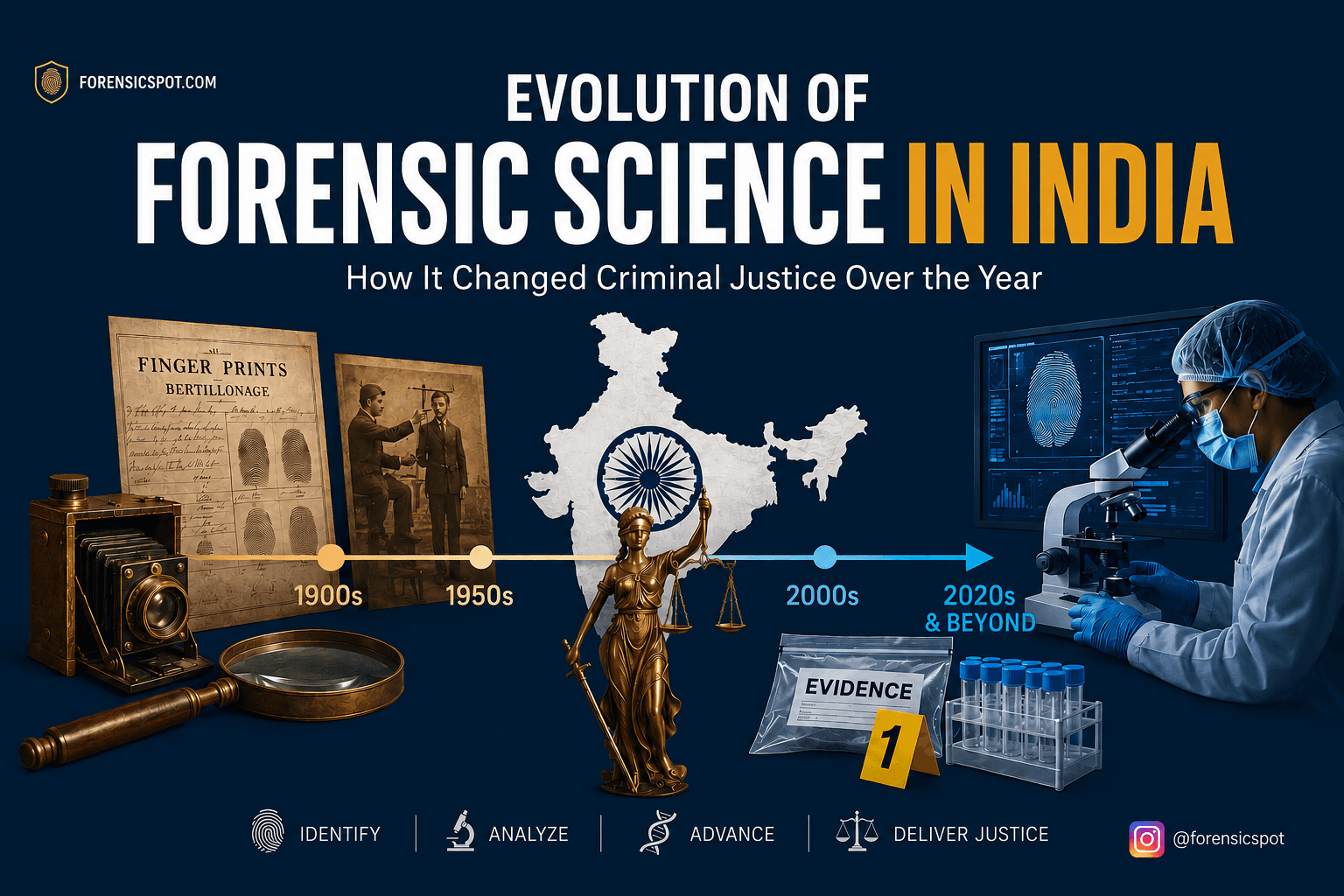
The post – Independence era led to various social and economic reforms in India , The early green revolution period begun because agriculture and food production were rapidly transforming, Indian cinema was entering the famous “golden commercial era” with stars like Amitabh Bachchan rising to fame, During the early years, criminal investigations mainly depended on witness statements and traditional policing methods. However, with the rise in complex crimes, the need for scientific analysis became increasingly important, to counter this situation Indian government started various Scientific institutions and research laboratories, Police investigation methods were becoming more scientific, though traditional investigative approaches still dominated. Basically, in the post-independence era a transitional period where India began moving from traditional policing methods toward scientific criminal investigation.

Establishment of Forensic Laboratories (prior Independence):
The pioneering of forensic science in India began with the establishment of the Chemical Examiner Lab during the British rule in 1849 in Madras (now Chennai), The main function of the lab that time was to assist the local police in the complex cases like poisoning, biological samples, and chemical samples. This lab later become the foundation stone of the forensic science in India that led to development and establishment of the different forensic science lab in India, to improve the evidence handling process and strengthen the criminal justice system in India, The beginning of the scientific examination on the investigation of case began with the establishment of various laboratories in India.

Sir Edward Richard Henry was a British police officer and innovator in forensic identification; he introduced the Henry fingerprint classification system in 1897.
Edward Henry along with Azizul Haque and Hem Chandra Bose developed a mathematical system for classifying fingerprints, which made identification of criminals much faster and more accurate. Before this system, police records were maintained manually, and it was very difficult to identify repeat offenders. The Henry Classification System was first adopted in India and later became popular in many other countries including the United Kingdom. This contribution became one of the biggest milestones in the history of forensic science and criminal investigation.
In 1904, the world’s first Fingerprint Bureau was established in Calcutta (now Kolkata). The bureau played a major role in maintaining fingerprint records of criminals and suspects. This was considered a revolutionary step because fingerprints provided a unique identity to every individual and reduced dependence on eyewitness accounts, which were often unreliable. The use of fingerprint evidence slowly increased the accuracy of criminal investigations and helped police solve many difficult cases.
During the early 20th century, forensic science in India continued to expand with the establishment of more laboratories and scientific departments. Handwriting examination, toxicology, ballistic analysis, and serology started becoming important parts of criminal investigations. The role of medical experts and scientific officers also increased in court proceedings. Scientific evidence started gaining more trust because it was based on facts and laboratory examination rather than assumptions.
After independence in 1947, India focused on strengthening its criminal justice system and scientific institutions. Various state forensic science laboratories were established to assist police departments in scientific investigation. The Government of India realised that modern crimes required modern investigative techniques. As a result, forensic science slowly became an important support system for law enforcement agencies.
One of the major developments came in 1952 with the establishment of the Central Forensic Science Laboratory (CFSL). The laboratory was created to provide advanced forensic services to central investigating agencies and state police departments. Over time, more CFSL branches were established in different cities of India. These laboratories handled examination of fingerprints, questioned documents, narcotic substances, explosives, firearms, biological evidence, and many other types of forensic material.
In the 1970s and 1980s, forensic science saw rapid growth in India. Crime rates were increasing in urban areas, and investigators required better scientific support to solve cases related to homicide, fraud, terrorism, and organized crime. During this period, new divisions such as forensic ballistics, forensic toxicology, forensic biology, and forensic photography became more advanced. Scientific methods were increasingly used in courts, and expert testimony became an important part of criminal trials.
The introduction of DNA fingerprinting in the late 1980s and early 1990s completely changed forensic investigations in India. DNA technology provided highly accurate identification of individuals through biological samples like blood, hair, saliva, and semen. It became extremely useful in murder cases, sexual assault investigations, paternity disputes, and identification of unknown bodies. The establishment of the Centre for DNA Fingerprinting and Diagnostics (CDFD) further strengthened forensic research and development in India.
Another important achievement was the growth of cyber forensics during the 21st century. With the increase in internet usage, digital crimes such as hacking, online fraud, identity theft, and cyber terrorism also increased rapidly. To deal with such crimes, forensic experts started using digital investigation techniques for recovering deleted files, tracing IP addresses, analysing mobile phones, and examining electronic evidence. Cyber forensic laboratories were established to support modern investigations and protect digital security.
Today, forensic science has become one of the strongest pillars of the Indian criminal justice system. Modern forensic laboratories use advanced technologies such as DNA profiling, artificial intelligence, facial recognition, digital forensics, and automated fingerprint identification systems. Scientific evidence is now considered more reliable and objective in comparison to traditional investigation methods alone.
Despite these developments, forensic science in India still faces several challenges such as shortage of experts, lack of advanced infrastructure in some states, delay in forensic reports, and increasing workload on laboratories. However, continuous improvements, government initiatives, and growing awareness are helping forensic science become more efficient and accessible across the country.

The evolution of forensic science in India clearly shows how scientific innovation transformed criminal investigation from traditional policing methods to evidence-based investigation. From the establishment of the Chemical Examiner Lab in 1849 to the use of modern DNA and cyber forensic technologies today, forensic science has played a major role in strengthening justice delivery and improving the investigation process in India.
Tagged: forensic science india, evolution of forensic science, criminal justice system, indian forensic history, dna profiling india, fingerprint analysis, cyber forensics, forensic laboratories india, crime investigation, forensic technology, indian criminal investigation, forensic science timeline